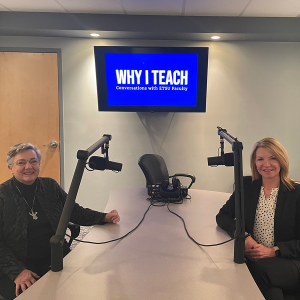
Tuesday Jan 10, 2023
Episode 09: Dr. Virginia Foley
Dr. Virginia Foley has decades of experience in education, first as an educator and administrator in the K-12 setting and then transitioning to higher education in 2007. As a faculty member in ETSU's Clemmer College, she prepares students to make a difference in the classroom. She is also making an impact in the boardroom, where she serves as the Faculty Trustee on the ETSU Board of Trustees.
Podcast Transcript:
Dr. Virginia Foley
The big idea for our program is that leadership is a moral craft. And so I hope our students assume that responsibility for the moral purpose of leading schools and caring for students.
Provost Kimberly D. McCorkle
Hi, I'm Kimberly McCorkle, provost and senior vice president for academics at East Tennessee State University. From the moment I arrived on this campus, I've been inspired by our faculty, their passion for what they do, their belief in the power of higher education, and the way they are transforming the lives of their students. This podcast is dedicated to them: Our incredible faculty at ETSU. Hear their stories as they tell us why I teach.
In this episode, we will talk with Dr. Virginia Foley, a professor in the Department of Educational Leadership and Policy Analysis in the Clemmer College. Dr. Foley joined ETSU in 2007 after serving many years as a K-12 educator and administrator in Georgia. She is a past president of the ETSU Faculty Senate. As a faculty member, she has chaired over 100 doctoral dissertations. She also serves as the faculty trustee on the ETSU Board of Trustees. Enjoy the show!
Dr. Foley, welcome to our show.
I start every podcast with the same question for each guest: Take me back to your first day of teaching at ETSU as a faculty member. Looking back on that day, what is one piece of advice that you would have given yourself?
Dr. Virginia Foley
I think the biggest piece of advice I would give myself is that you have time. Most of my students that I teach, I will work with over two years and so I don't have to hurry up and try to dump everything in them. I have time to watch them grow. I have time to grow myself. Starting here, I frequently said I was fluent in K-12, I understood the K-12 education world very well, but I was learning higher ed, and so I had to give myself time with that also.
Provost Kimberly D. McCorkle
That's wonderful.
So you spent several years as a public school counselor and a principal in Georgia before you began a second career as a faculty member here at ETSU. Talk about how your previous professional experiences have shaped your career in higher education.
Dr. Virginia Foley
I was a couns– school counselor for 20 years, and I think that those experiences and the training I received as a school counselor prepared me well for leadership roles because it's about building relationships and it's about listening – deep listening. As a school principal, I would not have been able to do the job I'm in currently if I hadn't served in that capacity, because everyone who teaches in our licensure program either is or has been a school principal. So we're preparing school principals; we want people who are teaching them to have walked that walk. I retired from the central office and that probably was the best preparation for my career here because it was things I learned while there that really shaped the way I teach.
We were bringing some work into our district and training our teachers in understanding by design. It's a framework by Grant Wiggins and Jay McTighe, and had I not had that framework, I would not be teaching the way I'm teaching now. So it's identifying what are the big ideas you want students to walk away with, and how are you going to know what evidence do they have to provide you that they understand those concepts bone-deep, and then how do you structure experiences to give them that deep understanding? Had I not had that opportunity in that training before I came, my students probably would have been reading a lot, writing a lot, taking tests. And as it is now, the experiences are structured very differently.
Provost Kimberly D. McCorkle
Yeah, they... they've transformed the way you teach.
Dr. Virginia Foley
Definitely.
Provost Kimberly D. McCorkle
So most of your students are current teachers, as you mentioned. What is it like for those teachers to return to the classroom as students?
Dr. Virginia Foley
The hardest thing for them is to get used to the fact that grades are not what drives things. They’re teachers and they are always used to being successful and getting good grades. So they want to know, am I doing what you want me to do? That's a big adjustment for them because I tell them it's about the learning and we're not going to worry about the grade and that if they do what they need to do and they're learning and they're giving me evidence of learning, they'll get the “A” that they want. But other than that, they get a lot of detailed feedback. And if they're not on track for that grade, then I'll let them know and let them know what they need to do to get the grade they want to get.
So that huge adjustment, but it’s also them writing your first paper again after you've been out of school for a while and giving your first presentation to your peers after you've been out of school for a while, so there's some adjustment there, but we do a lot of developing and laughing and we are all learning together.
It's always interesting when professionals become students again.
Provost Kimberly D. McCorkle
Because your students are working full time, how do you structure your programs is it online, in-person, a mix of those?
Dr. Virginia Foley
Ours is a mix of both. When I first came to ETSU, we were teaching night, so I taught on Monday night from four, supposed to be from four to 10. It was technically about four-thirty to nine-thirty; after they'd worked all day. And then I taught on Wednesday night, same time. After I'd been here a couple of years, we switched to Saturday classes.
And so when we meet face to face, we meet on Saturdays from nine to about three-thirty. We go to lunch as a group, so we're eating together. Sometimes it’s an extension of conversations that happened that morning; sometimes it's just getting to know each other. Breaking bread is a great way of building relationships, and so that's how we structure our Saturday.
An unintended benefit of the change to Saturday classes was that we didn't have to be regionally-based anymore. We were using a cohort model, but people could come from everywhere. So we weren't driving to Morristown for a cohort and people coming from that area. In our first cohort on Saturdays, we did have people from Morristown, from Maryville, from Asheville, and then from our Tri-Cities area. But now with our cohorts, it's not uncommon for me to have people from Nashville, from Memphis, from Jackson. So they're coming from everywhere. And that just makes the cohort experience that much richer because of the diverse perspectives and experiences that people bring.
Provost Kimberly D. McCorkle
That’s great; and I would imagine that the Saturday format is in some ways preferable to the weekly meetings?
Dr. Virginia Foley
It is so much better. And we don't– we meet– we don't meet every Saturday, you know, we have a certain number a semester, but the Saturday also helps because they're not fatigue after having taught all day long. We get there with energy and then I think we all leave tired. But it does make a difference.
And then the remainder of the coursework is online, but it's structured pretty tightly with weekly discussions. And then there are papers and there are presentations that are both virtual and face-to-face.
Provost Kimberly D. McCorkle
And I would imagine that part of the benefit is that they're building those professional relationships with each other – with you, but with others.
Dr. Virginia Foley
With each other also, yes. I think our students will tell you that the internship that they get in our program and the cohort structure are two of the biggest things they take away – and lunch; they’re one of their favorite things is lunch on Saturday.
Tell me a little bit about the internship model then that you mentioned.
Dr. Virginia Foley
We have the most extensive internship in the state. We have a minimum requirement of 540 hours, and 100 of that is at elementary, 100 at middle school, 100 at high school, 100 at central office, and then 140 that are split between community and diversity which... a minimum of 40 in one of those. But students could get 70 and 70, they could get 90 and 50. But most of our students finish the internship with over 700 hours.
We tell them, Don't stop counting, because when you're interviewing for jobs and you say, Well, my internship requirement was 540, but I was able to get 700 hours.
And the internships experience are documented, they're aligned to standards. If you're a student in Tennessee, they're aligned to our Tennessee instructional leaders standards. If you're a student from another state, then we're aligned to the professional standards for educational leaders, which are national standards. And that's what our licensure exam is based on.
So everybody gets exposure to those standards also. Students are getting a very rich internship experience. They have mentors that they identify. Our requirement for their mentors are that they have to either be or have been a school principal. And then we have an internship supervisor who makes regular visits with interns and their mentors.
Provost Kimberly D. McCorkle
And every student has to experience every level.
Dr. Virginia Foley
They do have to experience every level because... your license is K-12. And one of the people who begged for no elementary, her first principalship was in a K-8 school. Another person who was an early childhood person, his first assistantship was at a high school, and he became a K-8 principal, and now he's a high school principal.
Provost Kimberly D. McCorkle
Is it true that middle school principalship is the hardest, or is that just a myth?
Dr. Virginia Foley
If you love middle school children, students, it's not hard. And that was where the majority of my principalship was, was in a middle school. And I love those kids, that aged kid. If you don't like them, it can be really hard because they are just all over the place. One minute they're a kid, the next minute they think they're 28. And they're trying on different identities almost daily. It's just them trying to figure out where they belong as they separate from family and form their own groups.
I think my counseling experience prepared me well for that principalship.
Provost Kimberly D. McCorkle
So I noticed under your current research on your bio page that you noted that your research interests are, “everything that my dissertation students are currently researching”. Talk about your process of mentoring doctoral students and some of the most interesting things that you've learned from your students.
Dr. Virginia Foley
Well, when it comes to mentoring doctoral students in dissertations, one of the most important things about teaching is know who you're teaching. And so different students need different approaches and different things. Some are just ready to get it done. They love this part of the education and they are just marching on. And some need that... all of a sudden they feel abandoned. It's like they've had coursework, they've had deadlines, and then they're they're kind of on their own, so I've learned to help build in deadlines, especially for those who need it.
And if I say, this is due to me then some of those students will not miss deadline. Some of them just, Well I know it's a guideline; so they just keep going on. So I nag, I cheer, I encourage, I celebrate. So it's just different approaches with different students.
But some of the topics have been really fascinating. I had within the same time frame, within two or three years, I think I had four different students that did their dissertations research on freshmen academies because that was a movement for a period of time.
And then I had a student who was looking at female leadership. And a serendipitous discovery was the role of mentors. She uncovered this network of women who were all mentored by the same woman. And it was a total surprise, but this woman knew that females needed mentors. So she started a book group, and then out of that book group then mentored people.
I had a student who was studying teacher development in Malawi. And the definition of rural in Malawi was if you had to walk more than two and a half hours from the town center to get to the school, that was a rural school.
And one of my students really looked at money and per pupil expenditure and then its relation to student success on typical measures. And basically what he found was it doesn't matter. And so these schools that have low per pupil expenditure but are very successful, we all need to go find out what they're doing.
Provost Kimberly D. McCorkle
How do you help students sometimes who are struggling in identifying a topic?
Dr. Virginia Foley
I tell them that by the beginning of their fourth semester they really need to be firm. And so we've talked throughout on things they're interested in, but they really need to get clear. And then recently our P-12 part of our department has really built in some checkpoints along the way.
And even with all that, you have students who change their mind. But I believe that if you're doing something that you're interested in that matters to you, it makes the work a lot easier.
So you're now in your second term as the faculty trustee for the ETSU Board of Trustees. Will you tell us about your role on the board?
I have thoroughly enjoyed the privilege of serving on the board, and I didn't mean to run for a second term, but the pandemic occurred. I was six months into my first year of my first term, and then we all went remote and then our meetings were remote. I just really felt like that I could learn more if I were able to serve a second term. And so I ran again and was elected.
I think my job on the board is to first read thoroughly all the board materials, even on the committees I'm not serving on because I feel obligated to faculty that if there's something that might impact faculty, I just need to point that out.
I attend every committee meeting. The people that are on the other trustees are so committed to the success at ETSU and we're all pulling in the same direction.
My role on the board really is to talk about... just every now and then say, But this is how this rolled out, because of information I have that they don't have, because they don't live here. I mean live at ETSU.
Bottom line, my role as a trustee is the same as anybody else's; is to make decisions for the university that make the university stronger and better.
Provost Kimberly D. McCorkle
Can you share with us maybe one of the most rewarding experiences you've had in serving as the faculty trustee?
Dr. Virginia Foley
I think I always like to welcome faculty back at Convocation. I love the new ceremony for tenure and promotion. I think the Heroes ceremony that we had last year that honored the people who just stepped up during the initial stages of the pandemic was probably the most moving experience that I've had.
Provost Kimberly D. McCorkle
Finally, what impact do you hope that you have made on your students?
Dr. Virginia Foley
The big idea for our program is that leadership is a moral craft. And so I hope our students assume that responsibility for the moral purpose of leading schools and caring for students. You cannot delegate responsibility for that moral purpose. You can delegate other aspects of the job, but not keeping the focus on the vision and moving the school in that direction.
Provost Kimberly D. McCorkle
Thank you, Virginia. From your work in the classroom to your service on the ETSU Board of Trustees, your work is truly making a difference in the lives of our students.
Thanks for listening to Why I Teach.