Monday Dec 12, 2022
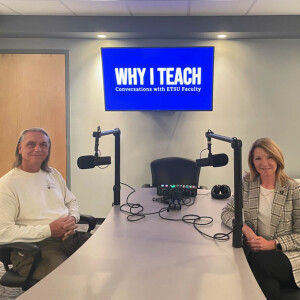
Episode 08: Dr. Mike Stoots
ETSU College of Public Health's Project EARTH, located at the ETSU-Eastman Valleybrook campus, has received national recognition for its curriculum. Dr. Mike Stoots describes some of the hands-on learning opportunities taking place there and why he enjoys teaching in this innovative program.
Podcast Transcript:
Dr. Mike Stoots
So Project EARTH started off making products. Now we have classes; we have community experiences. People come in and it's still centered around solutions to low-resource health challenges, but it focuses on team building, innovation, and resilience.
Provost Kimberly D. McCorkle
Hi, I'm Kimberly McCorkle, provost and senior vice president for academics at East Tennessee State University. From the moment I arrived on this campus, I have been inspired by our faculty. Their passion for what they do. Their belief in the power of higher education. And the way that they are transforming the lives of their students. This podcast is dedicated to them, our incredible faculty at ETSU. Hear their stories as they tell us "Why I Teach." In this episode, we will talk with Dr. Mike Stoots with the ETSU College of Public Health. Mike is one of the longest-serving faculty members in the College of Public Health and is also the director of operations for the award-winning Project EARTH, located at the ETSU Eastman Valleybrook campus. Enjoy the show.
Dr. Stoots, welcome to our show.
Dr. Mike Stoots
Thank you.
Provost Kimberly D. McCorkle
I start my podcast with the same question for every guest. Take me back to your first day of teaching at ETSU as a faculty member. Looking back on that first day, what's one piece of advice you would have given yourself?
Dr. Mike Stoots
Well, I can certainly remember the first class. Not so much about the first day, but the first class I taught was in the ground floor of Lamb Hall. It was a – back then, it was a personal health course. So I had my book, my notes. I walked in. There were probably 40 people in the room. I remember going to the podium, opening the book, laying my notes out, grabbing both sides of the podium, and starting to talk. I think I looked up one time at the back wall, looked down, looked at my watch, and said, "Okay, that's it for the day." And walked out. First one out the door. Terrified. Yeah.
If I could go back and be in the hallway that day, I would have one piece of advice with three parts. The first one I would tell myself is "Just relax." And treat all students with respect and appreciation that they're there.
The second one would be there are sort of three ways to talk to a group. The first one is to talk at a group, and that's certainly what I did that first day. I was talking at people, and more, really, I was talking to the back wall, wasn't really talking to anyone. And I work with new faculty now, and I tell them that this is a process that takes time. So you can start off talking at people, and then you can talk to people. This is when we have good eye contact. We express ourselves well.
But then the third way is talking with people. Now, this is when the instructor isn't the center of attention anymore, and you give the students more time in the classroom to interact. This is a challenge because you give up control. And sometimes students may not provide the comments that you're looking for. And it's a real art to be able to steer the conversation back in the right direction without becoming a dominating force. So I'm not sure I would have listened back then, but that's what I would say now to that person clinging to the podium.
Provost Kimberly D. McCorkle
Great advice. Yeah.
So I know that you're also an ETSU alumnus. And as someone who's relatively new to the ETSU community, I'm fascinated to hear about how the campus has grown and changed. What's changed the most since you first joined ETSU?
Dr. Mike Stoots
The student population was much lower then, and there was room. I remember people being in the front yard of Brown and around the center of campus, and people just were outside. And then over the years, as the enrollment grew, those spaces became smaller and smaller, and it became almost an industrial feel. There were buildings, there were parking lots, and not a lot else. But now with the new green space all over campus, you see people outside more. It's really a full circle from being a nice, quaint little college back in the day to now a university that is very student-centered.
Provost Kimberly D. McCorkle
Yeah. Did you take classes in Brown?
Dr. Mike Stoots
I did. I had classes in every building, I think. I had a couple of undergraduate majors and my master's in public health and almost a master's in exercise science. Wow. So I’ve been all over campus.
Provost Kimberly D. McCorkle
I always think it's neat to think that you took classes and later you taught in those same spaces. Did that happen to you?
Dr. Mike Stoots
Oh, it did. Yeah? Several times.
Provost Kimberly D. McCorkle
That's great.
During your time at ETSU, you have helped to develop a curriculum that sets the ETSU College of Public Health apart from other universities. For those who have not heard about our nationally award-winning curriculum and public health simulation lab, please tell us about Project EARTH and the Niswonger Village.
Dr. Mike Stoots
Project EARTH began with two of our students – our master's students – returning from Africa after a semester-long internship, and they both had worked in clean water in different countries, and they put in bios and water filters. After they presented on these topics, Dean Wykoff and I were in the back of the room, watching their presentations, and when it was all over, we said, "That is a wonderful thing they're doing." Clean water is a foundational element of public health and health around the world. But we were talking about that and said it's a real shame we didn't teach them how to do that. They picked that up and educated themselves on biosand water filters. And we were discussing it further, and we thought, "Wouldn't it be great if we could teach them that?"
Well, then the stars aligned, and Eastman Chemical was gracious in donating the Eastman Valleybrook campus to the university. And we had a small space there, one room, and we started teaching a select group of students how to make biosand water filters, indoor cookstoves, how to build with adobe. And from that, it started to grow, and we were centering on product development. But then we started noticing and the students started telling us that while learning the products was great, they were learning teamwork, innovation, and resilience. Yeah.
And at the same time that was happening, again, the stars aligned for us, the workplace, all the different workplaces, they were telling us that we need graduates who are good team members, who can be innovative and creative and who are resilient, can maybe work in an environment they're not used to, and get through that and excel in something they're not quite used to.
So once this got started, we spent years developing individual programs where students participate in activities, develop team building, innovation, and resilience. We put them in a situation outside the classroom: no tables, no chairs, no fluorescent lighting. They may be in a workshop; they may be outside. And we have activities that community members come in and do, maybe an hour activity, or it could be a three-day activity.
So Project EARTH started off making products. Now we have classes, we have community experiences where people come in, and it's still centered around solutions to the low-resource health challenges. But it focuses on team building, innovation, and resilience.
Provost Kimberly D. McCorkle
And you've built this hands-on kind of curriculum into many of your classes and programs across the college, haven't you?
Dr. Mike Stoots
Yes, we have multiple undergraduate classes, one of the doctoral seminar classes, they participate in it, and the students are given a challenge, a health challenge. And with that challenge, they have to learn certain basic tools, the skills. It may be driving nails; it may be reading a tape measure, sawing lumber. But then they take those new skills, and they make adobe molds. Then they make adobe bricks, and then they make an adobe cookstove.
But it's really not about whether a student can drive nails or read a tape measure. It's about can a student come out and see a challenge, come up with a solution for the challenge, and then find out what the skills are required to meet the challenge and go learn those skills and implement them. We can't tell the students what the challenges are going to be in the next 20 years, what the next pandemic will be. But if they have a very rich method of thinking and being creative and they're resilient, I think they're going to be prepared for those challenges.
I had the opportunity to visit the facility, and when I was there, the students showed me some crops they'd grown in the garden, and some shoes that they had made. These hands-on experiences seem to be so impactful. It seems to be. And we call it the great equalizer, too. We may have a student who doesn't excel in the classroom with typical lecture and exams, and they'll come out and possibly excel in the workshop. Or a student who is not as confident in themselves as we would like. And they'll learn to do some of these things they've never done before. And some of them have been told they can't do it. So they develop this confidence, and then when they're in our computer lab doing a project or something else, that confidence follows them into the classroom.
Provost Kimberly D. McCorkle
Yeah.
So I've heard both you and Dean Wykoff describe the importance of this approach, and I believe you've also published about it. Can you tell us a little bit about that?
Dr. Mike Stoots
Yes, we published “Ten Years of Teaching Hands-On Public Health.” And what we did was a summation of lessons learned. And one of the lessons was to get out of the way; give the students the task and the challenge and let them fail.
Now, in higher education, when you talk about a student failing, it usually sends off red flags and reports and ... but without the ability and the opportunity to fail, creativity doesn't happen. So we actually give them challenges sometimes that are extremely difficult, knowing that they probably won't succeed, but then they'll come back and do it the second time or the third time or the fourth time, and then succeed.
Which sometimes when you tell a group of students that we're going to do this five or six times, they're like, “No, we're not; we're going to do it one and turn it in.” But it's that process. It has to be the process.
Provost Kimberly D. McCorkle
What do you see as the future moving forward for Project EARTH?
Dr. Mike Stoots
Well, as I said, we started off with products, cookstoves, water filters, and we are now back to those things and other issues. And we've always had a desire to involve more community members and organizations, and we are doing that now. So we have different projects within Project EARTH, and we have involved different groups, and those are starting to stand up on their own, be it with beekeeping or agricultural products or other areas. We have AdaptoPlay, our bike program, so it’s standing up.
When we first started, we were focusing a little more than I think we needed to on the international health and the low-resource challenges. There's low-resource health challenges in Unicoi County, where I live. You don't have to fly across an ocean to find these challenges, but the dean and I were talking about what if we could create something so that our students who will never travel abroad, what if we could show them how people live? And we sketched some things out on the back of a napkin.
And Dr. Stanton, when he was here, had mentioned the idea to Scott Niswonger, and he came out and walked around the property and talked to us about it and then, very kind and gracious, Scott and Nikki Niswonger donated – underwrote – the village for us, so we built the Niswonger Village at Valleybrook.
And that consists of homes from around the world. And these aren’t Google images that we found; we've had students in almost every home. They come back with stories of the families and the kids. Even one home, we built the front door based on a picture of the student standing in the front door of the house in Rwanda.
And that program is growing now. We have mock epidemics where our doctoral students go from house to house and interview the actors in each house to determine what's going on in the village. We're working on a day program right now where you would come out to the village, and you would live the life of the people from that home. You would cook the way they cook; you would wash your clothes the way they wash theirs. You would live without Wi-Fi – I know I just lost students there – but you would participate in that day. And we're not – that's not going to be like living in that situation. But it's certainly a glimpse.
Provost Kimberly D. McCorkle
Yeah. I love how you described it as an idea on the back of a napkin. I think sometimes those are the best ideas, right?
Dr. Mike Stoots
Yes.
Provost Kimberly D. McCorkle
At the Eastman Valleybrook campus, I understand that public health was one of the first academic programs to kind of move out to that space. Can you tell us a bit about that space and how it's developed over time?
Dr. Mike Stoots
It is – and I've said this a hundred times – the Eastman ETSU Valleybrook campus is the world's greatest classroom, from the acreage that it sits on to the wonderful facility indoors. We have a computer lab in the facility downstairs. We have a workshop that we can put 25 students in. It has allowed Project EARTH to develop. Without that facility, we could not do what we're doing.
Provost Kimberly D. McCorkle
It's such a unique space, right, for the work that you're doing. It is really the perfect space for what we're doing. And it has allowed us to grow and to continue to grow. And you bring all public health students out to that space at some point during their curriculum, don't you?
Dr. Mike Stoots
Yes. All public health students come out and participate in either a class or one of the day programs.
Provost Kimberly D. McCorkle
Mike, as you know, ETSU has recently launched our Quality Enhancement Plan, which is designed to encourage our students to go beyond the classroom and to strengthen our community-engaged learning opportunities for them. I see this as already taking place with your students through several programs such as the recycling program and AdaptoPlay. Please tell us about these programs and how they're connecting our students with the community while helping them build that valuable skill set that you've mentioned.
Dr. Mike Stoots
The recycling program is a little different than when you hear “recycling.” Ours is about re-engineering, contributing to youth charity, new-idea generation. And this program started with a meeting with the OmniSource professionals in town. They're a metal recycler, and we were actually talking about a different project. And the fact came up that they have lots of bicycles that they recycle every month, and they asked if we could do something with bicycles. And of course we said, "Well, we'll try." And that led us to creating a bike shop.
Now, in our bike shop, originally, we would take all these different bikes and find parts that we needed and put together bikes. And then they would go to the local Boys and Girls Club. And our students, our Public Health Student Association, they would teach CPR as a fundraiser, and they would buy helmets. So we would give bikes and helmets away. And then the Boys and Girls Club would distribute as needed.
So that program went on for a few years, very successful. And then we met some educators with the Kingsport City Schools, and they have a program where they find students jobs. And some of these students had no transportation to get to the workplace. So now we're working with Dobyns-Bennett High School, and we provide bikes, we put fenders on the bikes, we put a basket or a rack on the bike so the students can carry their belongings to their job and back. And we give them a bike helmet. That's been going on for a couple of years.
Another program, AdaptoPlay, started with a conference that Aimee Rowe and I attended in Nashville, and we saw the Go Baby Go presentation, and we had heard about this, and we talked about how it would fit within Project EARTH. And then we were approached by a couple of local physical therapists, and the key behind AdaptoPlay or the Go Baby Go movement is working with kids – mostly under 6, but not necessarily – who are differently abled. They have some sort of physical issue, and the best way it was explained to me was try to do physical therapy on a 2-year-old, tell the 2-year-old to do 15 reps of two sets turning your head or something. It just doesn't work.
So a gentleman at the University of Delaware had the idea of using small six- and 12–volt cars for these kids. So we started working with our community partners and worked with adapting cars. And you would take the little Jeeps, if you will. And the first example I was shown was a little girl, and she had trouble turning her head and couldn't use her hands. And the Jeep was then taken, the accelerator was put behind her head, so she moved her head to make the Jeep go. And then the steering wheel was altered so she could use it.
So you fast-forward two years from then, and now this little girl's looking forward. She's holding the steering wheel. That means that this person will use both eyes. She can now close her mouth so she can feed herself – you know, eat normally. And all this was accomplished with a Jeep that had $600 in it. We have electronic wheelchairs that were donated to us that were $50,000 new. So for $600, we changed someone's life. Yeah.
One of the great things about AdaptoPlay is when the child comes out and they've been fitted for the car and our maker team has made the car, and we have engineers who volunteer from the community, occupational therapists, physical therapists. So they've gotten the car ready, and the child comes out and gets in the car. When they first push the joystick or the accelerator, scares them to death. Because it moves.
Well then, a few minutes later, they sort of figure it out, and now they're moving. And when you watch that child move in that car, it may be 10 feet, that's enough. Because you have to realize that that is the first time that that little person has ever been able to move themselves on the earth. And you think, what would ... and now that's opened up their whole world. Yeah. Wow. And that, those five minutes make everything we've done worth it.
Provost Kimberly D. McCorkle
I love the way you describe it. I had the pleasure of meeting a couple of students who had been involved in that project, and they felt so connected to the work, but also so impacted by it.
Dr. Mike Stoots
And I think that's the best part, that you're involving our students in being able to do this. Yeah. Anymore - and I tell everyone this - I unlock doors, and I get people started, and then I just get out of the way, which is, that's how it should work.
Provost Kimberly D. McCorkle
What are you most proud about in terms of the teaching that you have developed, the style of teaching and through the work with Project EARTH and incorporating that across the public health curriculum?
Dr. Mike Stoots
That the teaching and the outcomes and the end users are all made real to the student. It's not theoretical. It's not something that you will do in the future. It's something that you're doing today, and it's going to help someone this afternoon or tomorrow, that we're trying to help people on campus and in the community every day.
Provost Kimberly D. McCorkle
So my last question: What impact do you hope that you've made on your students?
Dr. Mike Stoots
If I can teach one thing today that will improve the life of one kid that one of these students will have, it's a really good day. And our major is wonderful for seeing impact. I've had former students call me and talk about how they've lowered hospital infection rates or that they've reduced teen pregnancy in a city, county, or state. Or I remember one call that they've developed, this one student developed a program for a long-term-care facility. And when they did the program, she said, "That's the only time some of these people smile." And I thought, "Okay; that's good enough."
Provost Kimberly D. McCorkle
Yeah.
Thank you, Mike. I'm so impressed with the work that you're doing with Project EARTH and the community-engagement opportunities that you're offering to our students. I wish you all the best as you continue the next decade of what's next at the Eastman Valleybrook campus.
Thanks for listening to "Why I Teach." For more information on Dr. Stoots, Project EARTH, or this podcast series, visit the ETSU Provost website at etsu dot edu slash provost. You can follow me on Twitter at ETSU Provost. And if you enjoyed this episode, please take a moment to like and subscribe to “Why I Teach” wherever you listen to podcasts.