Friday Apr 17, 2026
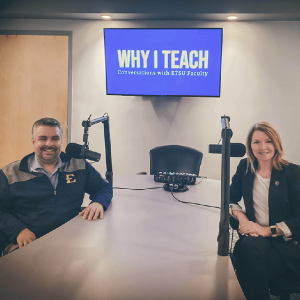
Episode 07: Mathew Desjardins
Mathew Desjardins, a member of the College of Business and Technology, is overseeing ETSU's innovative new BlueSky Tennessee Institute. This groundbreaking program provides Tennessee students the opportunity to earn a bachelor's degree in computing and a job offer at BlueCross in just over two years.
Podcast Transcript:
Professor Mathew Desjardins
Because the end goal is when they are done with our degree in 27 months and they graduate and they shake your hand and they shake Dr. Noland's hand at graduation, they leave with a job offer.
[Music]
Provost Kimberly D. McCorkle
Hi, I'm Kimberly McCorkle, Provost and Senior Vice President for Academics at East Tennessee State University. From the moment I arrived on this campus, I have been inspired by our faculty, their passion for what they do, their belief in the power of higher education, and the way they are transforming the lives of our students. This podcast is dedicated to them, our incredible faculty at ETSU. Hear their stories as they tell us, "Why I Teach."
In this episode, we will talk with Mathew Desjardins from the ETSU College of Business and Technology. Matthew is part of our Computing faculty and is currently overseeing our Blue Sky Tennessee Institute. Enjoy the show.
Professor Desjardins, welcome to our show. It's a pleasure to see you here today. First, I have to ask, did you drive the Tesla over today?
Professor Mathew Desjardins
I did drive the Tesla over today. Well, actually last night. I tried to come in the night before to get ready for an early day. So it's an interesting drive with a Tesla. You got to kind of let it go, its own control. But I, I trust it completely. It gets me from Chattanooga to here almost every week.
Provost Kimberly D. McCorkle
Now, well, I, I like how the Tesla is featured in, in a lot of what you do and the work that you do, so maybe we'll have a chance to talk more about that.
Professor Mathew Desjardins
Yeah, that'll be great.
Provost Kimberly D. McCorkle
I like to start my podcast out with the same question for every guest: Take me back to your first day of teaching at ETSU as a faculty member. Looking back on that day, what's one piece of advice that you would have given yourself?
Professor Mathew Desjardins
Man, I remember my first day teaching. Dr. Kelly Price, a former faculty member in the department, she gave me a chance to, as a graduate student, to teach for her, and at that moment, I was like, "Yeah, this is what I want to do." She really encouraged me to get to where I want, but I was kind of strict, I won't lie. You know, when you're first teaching, you're like, oh, oh man, all my other teachers were strict, right? I have to be strict. So if I can go back to Old Matt or Young Matt, I guess, I would be like: Matt, give them some slack. It's okay. They're students. Remember how it was to be a student. So that would be my one major advice. This is where you should be, yeah, but definitely give them a little more leeway because students go through a lot, and we forget that, I think sometimes.
Provost Kimberly D. McCorkle
Something I learned about you recently is that when you first attended as a college as an undergraduate student, things didn't go according to plan. You've been open about sharing the story. Would you tell us a little bit about that?
Professor Mathew Desjardins
Yeah. I came to school traditionally, right. Every student thinks, okay, you got to go to high school, then you come right out of high school and you're supposed to go to college. One major piece of advice is to listen to your mom. I should have listened to my mom. I left high school, coming to college, and I wanted to go into business. I, I love business; it's actually part of what I do in my current career in Computing. But my mom was like, "No, you're a Computing person. You do everything Computing, you have this very logical mindset." But I was like, "No, Mom. I want to go into business. I know better." So long story is I came to school, and business was not my thing. I don't think it was business or the classes. I think it was just my mindset. Some students don't realize the importance in higher education, and I didn't. I had no idea that I thought I knew better than everyone else. I thought that I can come and make my own life. I wanted to make money, so I ended up actually failing out my first three semesters, and I ended up coming back to ETSU because I wanted to better myself. But I also wanted to provide my knowledge to others and to give the opportunity to students to be like, okay, this is not for me. And now when I hear a student say that, I was like, well, I don't think that's the thing; it's let's find what it is for you. Maybe you made the same mistake I did. Maybe you ended up picking the wrong major. Maybe you just didn't connect with students; maybe you just need someone to say, hey, you can actually do this. I love my parents; they just didn't know or understand what college is. College is a full-time job; it's a job in its own, and if we come in the mentality like, hey, as faculty members we can help those students learn that school is a full-time job, that school takes a commitment, and school's not supposed to be easy. Nothing of value is supposed to be easy, and that's what I learned over those 10 years before I came back.
Provost Kimberly D. McCorkle
It sounds like those prior experiences really shaped you as a faculty member and shaped the way that you approach your students now.
Professor Mathew Desjardins
Absolutely. I always say I wish I didn't do that gap, but without that gap I wouldn't be the person I am today.
Provost Kimberly D. McCorkle
Yeah. I've heard you say many times that you learn as much from your students as they learn from you. Can you tell us a little bit more about that?
Professor Mathew Desjardins
Absolutely. I have amazing alumni, but I have a long list of these students that really inspire me to do better, anywhere from doing more research to improve my skills, introducing me to new topics, so these students push me. They challenge me to try new things. They challenge me to understand that, hey, they're human. But I also, through them, show them that faculty members are human, too. And so we have lives, we have interests. I'm down to go to a football game with the students. I had one of the Blue Sky students up here last weekend for the football game. Even though it was dreary, rainy, we still had a good time, 'cause I think allowing students to see that we're both human and understand that we want the same thing—to better each other. And so I learn that from my students, and every time I get in front of a classroom it's not me telling them what my knowledge is; it's also me taking a moment to let them tell me their knowledge and what they have passions for. Creating a learning community, it sounds like that's it. I don't have this like teacher-student; I have more of like, hey, I'm a guide. So I have this knowledge that I want to share to you, and let me guide you through these challenges of what life is called and see if we can figure out what is your best pathway. I used Dr. Dula a lot and you probably have heard Dr. Dula from many people around here, but Dr. Dula in one of his lectures he says college or a degree doesn't make you better; a degree just opens more doors. And I want to take that spirit of what I had when I had Dr. Dula and his lectures that I still watch to today about how a degree just opens doors, and I want to spread that knowledge. For me, the students are opening doors for me as we go through.
Provost Kimberly D. McCorkle
That's fantastic.
So you work in a field, computing, that is constantly changing. How do you stay abreast of all the changes in your field?
Professor Mathew Desjardins
Our field changes daily. I feel like I talk with our faculty, I'm like, hey, this just happened or hey, this just happened. I would say definitely my colleagues—I want to thank every single person that I've worked with and now in the past—their knowledge that they passed on to me that our field is changing is what allows me to keep changing. I'm a person that doesn't like stagnation, so I definitely, I think I'm definitely in the right field because learning new things every day, seeing new challenges, changing our curriculum almost semesterly—you know, we have to change what we do, what we teach, what we are learning ourselves. So definitely our faculty, but our students—I think our students bring so much nuance. They come and they're like, hey, I heard this or hey, I play this or hey, I want to build the next self-driving car, right? And so we get these ideas from our faculty, we get these ideas from our students, and I think the combination of those two is what allows me to stay current to the point now where I love our curriculum development. So, you know, I'm definitely involved with our development at both the college and our department, but also at the University. So I like curriculum, for us, is what drives students to want to come to us, and I think curriculum is just as much like technology. In all of our curriculum, I know there's many changes that are coming through the university, which is a good thing. It means that we all as faculty are staying current and wanting new changes.
Provost Kimberly D. McCorkle
So it's important to keep the curriculum relevant to help serve students and their future goals, right?
Professor Mathew Desjardins
Absolutely, and I love that here at ETSU we have a range of everything, and what's really nice though is Computing is kind of central to it all. I always challenge my students: I'm like, all right, Computing is involved with everything—find me something that there's not a need for someone in Computing. You know, we're sitting here in a recording studio and there's a computer that's recording us and managing all this, and so from recording to rocket science to medical schools—you know, the robot over in Quillen—I think there's a chance for us to always be part of everything that's going on.
Provost Kimberly D. McCorkle
Yeah.
So I want to shift gears a little bit. This is a momentous fall as we're launching a wonderful new initiative, our Blue Sky Tennessee Institute. So you have been spending a lot of time in Chattanooga recently helping to launch that Institute. Please tell us about the Institute.
Professor Mathew Desjardins
Yes. The Blue Sky Tennessee Institute—and I'll—Blue Sky has been my life since 2019, actually even before then. So Blue Sky is Blue Cross Blue Shield wanting to build our workforce development. I mean, they put a request out to Tennessee universities saying, listen, we have this need, and their need is tech people, and we want to partner with some institution to provide these ready people to come and work for them. So in short, Blue Cross Blue Shield of Tennessee has a shortage of tech people. You wouldn't know that an insurance company actually has the majority of their employees in technology, and they need those people to keep the business going, and they were like, hey, let's see if we can get a partner to produce the needs. So Blue Cross Blue Shield has been an amazing partners. I want to really stress that because they did a lot of the legwork. They said, okay, we need to internally look at our business and actually know what we need from our employees, right? And so, you know, I think a lot of times we as faculty look at learning outcomes for students, but we don't really do well translating what learning outcomes look like into what an actual business needs from that—sort of the core competencies of the workforce, right? And so, like, you know, we say a student when they can leave they can defend cyber security, but in a business they like, can you actually handle an attack? Can you identify an attack? And so trying to map what they need versus what is being done in schools, they did the leg work to that. They hired a company to help them identify what these core things they needed. When they put that out here, the Department of Computing, with thanks to Dr. Noland and Dr. Pittarese, Dr. Bennett, and Mr. Hendrix, we all together put together a proposal to Blue Cross Blue Shield saying, hey, these are the courses and here's the things we can actually do for you, and here's where we're going to need your help a little bit. The help turns into internships. So these students—they're going through our program—so they're going through a traditional Computing degree; they're doing the information systems concentration. So it's a degree that any student here on Main Campus can do. The only thing we did a little bit different is they're not getting the same breaks; we're ensuring all classes are lining up in the prerequisite order, right? So they're going fall, winter, spring, summer. They get a couple breaks. They're going to have a little bit of winter break, but they'll have to do just their online winter course, so they'll be doing one online. They'll get spring break. They'll get a little time in the summer, but it's just kind of continuous for 27 months.
Provost Kimberly D. McCorkle
An accelerated process.
Professor Mathew Desjardins
It is. It's, you know, and sometimes we think accelerated as we're shortening credentials or we're trying to reduce the requirements, but they're getting the same education. It's the same time length; we're just ensuring that everything happens one after the other, right? They're also getting professional development. So again, going back to our amazing partners with Blue Cross, they are getting professional development, so the students are getting mentors from both their executive leadership team—so if someone at a vice president level or higher is actually mentoring them, someone actually has their CEO as a mentor giving them advice on how to go through—but then they're also getting what IT members, so the actual information technology folks that are in the workplace as mentors too. And so not only are they getting our education, they're getting professional experience, professional development. Because the end goal is when they are done with our degree in 27 months and they graduate and they shake your hand and they shake Dr. Noland's hand at graduation, they leave with a job offer from Blue Cross Blue Shield.
Provost Kimberly D. McCorkle
Wow.
Professor Mathew Desjardins
And instead of having to, like, figure out what they need to do over, you know, a year—'cause Blue Cross says it takes about a year for a student to transition from graduation to actual workforce—they've been doing this now for 27 months, so hopefully that time is much reduced, shortened.
Provost Kimberly D. McCorkle
So I am also very interested in the processes that you've built in to support students along the way. Can you tell us a little bit about the student support?
Professor Mathew Desjardins
Absolutely. Student support is number one. I'm a number one advocate for students, and which made me a very ideal candidate to go down there and represent ETSU in this partnership. I put students one, the department two, the university three, me last—but you know what's best for the students. Our students are our customers. Our students are our people that are coming to us wanting this knowledge, and so we need to do what's best for them. But we have other support. So not only me, we have the entire University supporting us. I have everyone from student life and enrollment; they have been down there many times. I can't thank them enough for all the work they're doing. Dedra Johnson in the CFAA having tutors ready on hand—she's been amazing support in that. But going back to our amazing partners, they hired a Student Success Specialist, so Melissa Graham—she's a Blue Cross Blue Shield employee. She works for the Blue Sky program. She's a former K–12 counselor, and so she knows what a traditional student coming out of high school would need. So she's looking at it from, you know, she's the academic support from ETSU and all of the services we offer—we got that—but Melissa is also coming in behind for crisis management alongside our Counseling Center. So she's identifying and meeting with these students, you know, every other week saying, hey, what's going on. Blue Cross is supporting them financially, you know, so this first cohort has a full last-dollar scholarship, right, which is really supportive. You know, money is not the most important thing, but it does make a burden on students which could cause stress, so some of our students can't live at home while they're doing this. So Blue Cross Blue Shield stepped up and said, hey, we can help with that. Our community foundations—the Benwood Foundation and the Community Chest of Chattanooga—have put in money towards this to help support these students, whether that's for food. All their books are being covered, all of their supplies; they're getting a laptop. These students have so much financial support. They're getting crisis management. They're getting social interaction by our cohort model, where it's a little bit different. You know, the people who are listening to this are like, oh man, this sounds amazing—how are you getting it done? Well, we put through some restrictions, right? So they're here treating it as a job, right? So they're in class 9 to 3. Do I teach that whole time? No. I teach my normal time, but then we have general education that's online, so we give them online time blocks. We have people come in for tutoring and support. We changed higher education slightly. You know, it's not the you-build-your-schedule-try-to-get-everything-in-on-like-a-two-hour-time-and-if-you-don't thing. We're very hybrid K–12 but with all the college courses built in around it. So it's fantastic.
Provost Kimberly D. McCorkle
What's the interest been among prospective students and their families?
Professor Mathew Desjardins
So we're in the process of interviewing for our next cohort of students, right? So we got 32 students, and let me—maybe this will put in perspective—we were originally only wanting to do 15, and the out—we had ended up last year having 96 people apply. Out of those 96 we chose 32.
Provost Kimberly D. McCorkle
Wow. So that was really, really amazing return—there's strong interest, absolutely, from the local community around Chattanooga and beyond.
Professor Mathew Desjardins
Absolutely. This year we're about 10 times larger in interest, so the initial applications coming in are about 10 times from what we were last year. The questions, the amount of tours and interviews that we've been doing with students and talking with students—it's grown exponentially.
Provost Kimberly D. McCorkle
That's fantastic.
Professor Mathew Desjardins
And I really do believe this is, you know, it might not be for everyone, and we do an interview process because we want to select the best candidates. And the best candidate is not academic; the best candidate is do they have an interest in our field, do they want leadership potential, do they have some interest in Computing. Because a lot of people think Computing is one thing and Computing's not another thing, and so we ask these interviews and we want, you know, if a student says, "Hey, I want to come to this program but I also want to do marching band," well, we don't have a marching band down in Chattanooga, so let's see if we can get you up to main campus and join our marching band up here because that would be a better experience for them. We don't just say yes to everyone. We take the best candidate that wants to complete something in 27 months and get a different college experience—a good one—but it'll be different. But if they want a traditional one, we try to get them up here. We have a student right now for whom it was better to go the traditional path, and we got him up here and he's loving it and he's killing it. And I love that it was best for him, and he's going to be a good case to say, hey, if we do this for this type of student, you know, we can see a good outcome for those. That's great. You help them with other kinds of off-ramps. Any student that I get to interact with, whether they get taught by me or they get taught by someone else—we need a better workforce; we need better people. Our future is in our students. Our future is not us—no offense—it's not us. Our future is who we're teaching. And if we can, you know, set a good foundation and a good groundwork for them to want to do exactly what I'm doing, then I did my job.
Provost Kimberly D. McCorkle
What's been the most impactful part of this experience for you?
Professor Mathew Desjardins
Oh man, the students. I mean, that's such a—oh, he's going to say the students—no, it really is the students. Dr. Noland recently came by and visited with Trustee Grisham, and those two people are just amazing people and I want to thank them very much for coming down. But you know, they were asking, I was like, why did you come into this program? Why did you do this? And every single one of the students was like, well, we really like the 27 months. You know, that was definitely a drive for them, but they liked that it was close by; they liked that it was ETSU because we are not a nameless institution, which is great, right? But they said the family, right? And for the past few days I've been hearing Dr. Noland talk about family. I've been hearing other faculty talk about family and staff members talk about family, and it's something that I talk about all the time: ETSU is a family. So I would say the most impactful is growing our family—being able to have these 32 students. I have a different interaction with these 32 students than I've had with any of my students ever. I could make those close interactions with a few of my students in the past, but I have these students five days a week, you know, eight hours. Some of those students are there from 8 in the morning till 11:00 at night; they don't want to leave, you know. And being able to go out to dinner with them and their families or go to lunch with them just to have a side conversation—I played a video game the other day with them—the interaction between these students has made me a better person. And so my biggest impact in this whole experience is being able to interact with these students on a different level that I think some of our faculty miss. I can build those personal relationships and I, I love it. I love every part of it.
Provost Kimberly D. McCorkle
I read on your social media recently that this has been the highlight of your teaching career so far.
Professor Mathew Desjardins
It has. I love teaching. You know, I told Dr. Countermine, the former chair of our department—he was the one who initially hired me into ETSU and I thank him for that—and that was a highlight in my career at that moment. And every time I teach it was always a highlight, and a highlight, and I love teaching. Last year, you know, seeing some of my students who had gone through the pandemic and didn't see them for almost a year and then got to see them and graduate—just that excitement of graduating. Well, I saw that excitement when I went to these 32 Blue Sky students' high school graduations. I walked in and they're like, "You came," and I was like, "Absolutely, congratulations, you came through high school." So now in 27 months we'll do this all over again, but it'll be blue and gold, you know, and they were really excited. And that moment where I had the ability to impact just one student—yeah—or now 32 students—a chance to get the degree that they want, a career that they want, a pathway in life that they want. Really, when I wake up every morning it's not, "Oh, I have to go to work," it's, "I can't wait to get to work," and that experience has been really great for me.
Provost Kimberly D. McCorkle
Well, your enthusiasm and excitement are evident. It also reminds me of a book that many of us have read over the last year, which is called Relationship Rich Education. It talks about the impact that these kinds of relationships and experiences have on student success, and it really highlights the importance of the student and faculty relationship and feeling like the student knows that he or she can rely on a faculty member to help sort of be that support system to get them through and the impact that that has on student success.
The last question I have for every guest: what impact do you hope your students will make on the world?
Professor Mathew Desjardins
Oh, that's a really deep question. You know I think students if students can just find what they're truly passionate about I found my passion and I don't plan on that passion Ever Changing uh I just want that passion to grow so if a student can find their passion they will naturally leave their mark on the world so if a student can go in and take the same passion I have to whatever they want to do whether that's in Computing whether that's in photography as fun or building a self-driving car or boating or just having a family if they can take the same passion that I'm trying to express to them and just know that people are people and we all are human and if they can go to the world like that I think that would be a what I would love my students to to leave with. It's great.
Provost Kimberly D. McCorkle
Thank you, Mathew. This is truly an exciting time for you, for the Blue Sky Institute, and for our Computing program at ETSU. Thank you for all you do for our students, and I wish you all the best for a successful wonderful fall semester.
Thank you for listening to Why I Teach. For more information on Professor Desjardins, the Blue Sky Institute, or this podcast series, visit the ETSU Provost website at etsu.edu. Or you can follow me on Twitter at ETSU Provost, and if you enjoyed this episode, please take a moment to like and subscribe to Why I Teach wherever you listen to podcasts. [Music]