Thursday May 26, 2022
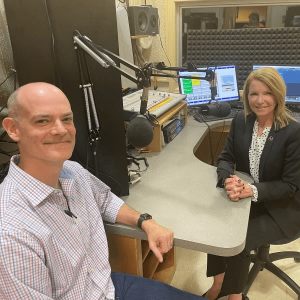
Episode 02: Dr. Sean Fox
In 2021, a group of ETSU students decided to nominate their professor Dr. Sean Fox for a teaching award. He went on to receive the Distinguished Faculty Award, the highest honor presented to an ETSU faculty member.
Podcast Transcript:
[Music]
Dr. Sean Fox
Graduation is always a special time. You get to meet your students' families that you've been interacting with for the past four or five years. There was one student, a nursing student, and she was in one of the first classes I ever taught, so it was very neat to be able to see her in that whole transition from me being a brand-new teacher and her being a brand new student to us both being on the same stage at the same time many years [Music] later.
Provost Kimberly D. McCorkle
Hi, I'm Kimberly McCorkle, Provost and Senior vice president for Academic Affairs at East Tennessee State University. From the moment I arrived on this campus, I have been inspired by our faculty, their passion for what they do, their belief in the power of higher education, and the way that they are transforming the lives of their students. This podcast is dedicated to them, our incredible faculty at ETSU. Hear their stories as they tell us why I teach.
In this episode, we will talk with Dr. Sean Fox, an instructor and laboratory coordinator in the Department of Health Sciences in ETSU's College of Public Health. Last fall, we presented Dr. Fox with the highest honor ever given to an ETSU faculty member, the Distinguished Faculty Award in Teaching.
Dr. Fox, as I was driving into campus today and passed University School, I was reminded that you began your ETSU story there as a seventh grader and now you're a faculty member at the university.
Dr. Sean Fox
That's correct, yes. My family moved here, and I started seventh grade and finished through high school at University school, and I enjoyed it, and it's kind of surreal to come back here and teach. In fact, if you had cornered me uh back then and said I would be an instructor here at ETSU I probably would have laughed ’cause I I was like many teenagers: I wanted to go away from home and experience things and and so yeah it my roots brought me back here to ETSU.
Provost Kimberly D. McCorkle
Now you have kids there at University School is that right?
Dr. Sean Fox
Yes, I have three kids, two of them are there. I have one that is in kindergarten and one that is in, ironically enough, seventh grade right now.
Provost Kimberly D. McCorkle
So I want to start this podcast out with the same question for every guest. Take me back to your first day at teaching at ETSU as a faculty member and looking back on that day what is one piece of advice that you would have given yourself?
Dr. Sean Fox
Well, I have two bits of advice I would give myself rather than one. One is a funny one, and one is a little more serious one. The funny one would be that you should always bring an extra change of clothes with you. It's the first day of classes I was getting ready to go teach my first lecture and we in the microbiology department have an autoclave and we have to put media in there to sterilize it before we use it in classes. And I had taken it out and I was kind of rushing to get ready for class and one of the bottles broke and the liquid that was in there went on my clothes and saturated it and it was some chemicals that was making my skin itch and so I had to change. But being an avid runner, the only clothes I had in my car were some running shorts, so I attended my first lecture, ever, at ETSU as a faculty member wearing a nice button-up shirt and running shorts. So memorable.
Provost Kimberly D. McCorkle
Absolutely absolutely.
Dr. Sean Fox
So, yes please bring an extra change of clothes with you always, but the the more serious thing I would go back and tell myself is that it's going to be okay. I know in these big life moments when you when you make these big big leaps in your career you get a little nervous that you're not prepared or maybe you're not ready for it but I would go back and say you you've got this great.
Provost Kimberly D. McCorkle
So walk me through your journey going back to when you graduated from University school and eventually returned as a doctoral student.
Dr. Sean Fox
Sure. University school was great. I had a fantastic high school education there and then I went to Virginia Commonwealth University for undergraduate school. I had ambitions and got my undergraduate degree in forensic science, which was a little bit different than what I'm doing now, but I had a really great mentor who kind of fashioned my interests there and helped me explore some different avenues. And so I finished my degree there, and my wife and I knew we wanted to come back to the the area uh we were planning on starting a family and so uh the Stars aligned and came back here and started the Ph.D. program at Quillen and had a great experience there as well. And then the opportunity to join as a faculty member opened up serendipitously at the end of my tenure in my Ph.D. and kind of made the smooth transition over to main campus.
Provost Kimberly D. McCorkle
Tell us more about the mentor that you had at VCU.
Dr. Sean Fox
Sure. Her name was Dr. Lloyd, and I had just on the chance reached out to one of her post doc students who was teaching one of my classes and said that I really wanted to get some research experience more so to help me in my career because I was pursuing forensic science at the time and lab experience would always be very beneficial to that. And so I was very appreciative that she took a chance on me, and she gave me a kind of wide open range to explore things in the laboratory, and it really paid off. I was a published author as an undergraduate. It really opened up the door for me down the road, so I'm always very appreciative of the chances that she took, and I try to keep that in mind whenever I take on research students as well. I try to keep that door open because you never know how it's going to shape or affect someone's life.
Provost Kimberly D. McCorkle
Yes, the impact of mentors—absolutely, absolutely.
Tell us about the courses that you teach at ETSU. I I understand you teach in some semesters over 100 students per semester.
Dr. Sean Fox
Yes. In some of my classes, I have 100 students in just that one class, but um uh most of the classes I teach are for the health science department. We have General Microbiology, which is a nice introductory course that our college uses, but also the College Arts and Sciences, so it's kind of a mixed bag of students that come in there. It's their first introduction to a real microbiology-based course, and it's got a lab associated with it. I also teach human genetics and I know I'm very very biased but I feel I'm very blessed to have those two topics because I think those are the two biggest topics that are out there right now. We’ve got this whole new world of microbiology, particularly pertaining to the pandemic we just went through, but also human genetics and genetics in general. Our advancement in that is just exploding now, so I feel very fortunate to be able to teach those classes.
I also teach a biomedical techniques class which is a very hands-on class where we teach students hands-on skills in research and development. We have a health care simulation class where we try to get our students some exposure to kind of the real-life experiences they would see out in healthcare facilities, uh, and then I also teach a supervised teaching class for master students, and what I do in there is help students learn to become their own teachers.
Provost Kimberly D. McCorkle
You have a range of students, then some who are laser focused, maybe on a career in microbiology or science, but you have others who are taking your class as a pre-med profession requirement, right?
Dr. Sean Fox
Right correct yes I'd say about 90% of the students that I come into contact with have some kind of future ambition in health care whether it be medical school or physicians assistant school or things like that, It's also interesting about 10% of the students I have no connection to it they're taking microbiology as maybe an elective that they've always been interested in or they want to know more about microbes or genetics so those are kind of a fun group and I always try to tease them and tell them I'm going to try to sway to the dark side in this class and over and try to pursue this.
Provost Kimberly D. McCorkle
It's great.
As I mentioned at the beginning of this segment, you received the Distinguished Faculty Award in Teaching last fall, and that's a huge honor, especially for someone who hasn't been teaching here for many years. What was your first reaction when you learned that you received that award?
Dr. Sean Fox
I'll be honest I was I was blown away by it. I had just received the college-level award for teaching, and I had no idea that this would be something in the works as well, so uh I was very humbled by it, but also very appreciative.
Provost Kimberly D. McCorkle
And I remember that the nomination for that award was actually spearheaded by your students, who collected over 20 nomination letters that had to have had special meaning for you.
Dr. Sean Fox
Absolutely, um, it was very neat to be able to see the impact that those 20 students took upon their own initiative. I had no idea that they were doing this, but seeing the letters of impact they had written to the committee, uh, was probably one of the highlights of my teaching career.
Provost Kimberly D. McCorkle
So, as the winner of that award, we asked you to deliver the commencement address last December, and you and I sat together on the stage, and I noticed that many of the graduates who crossed the stage seemed to know you. I'm assuming those were your former students. Tell me about that.
Dr. Sean Fox
Graduation is always a special time. You get to meet your students’ families that you've been interacting with for the past four or five years. There was one student in particular I think you're probably referring to and she was a nursing student and she was in one of the first classes I ever taught so it was very you know very neat to be able to see her in that whole transition from me being a brand new teacher and her being a brand new student to us both being on the same stage at the same time many years later.
Provost Kimberly D. McCorkle
You shared that moment?
Dr. Sean Fox
Yes, it was, it was wonderful.
Provost Kimberly D. McCorkle
So you talked about teaching the genetics course. So much groundbreaking information and discoveries are being introduced in that field. How do you stay abreast of new topics?
Dr. Sean Fox
It is really hard genetics we've probably learned more about it in the last 20 years than we have in the last 100 years and so there's constantly new information and new discoveries and we're even finding things that we've kind of held tried and true over the many years that they're actually different than what we thought they were going to be so I typically have to update that class every year and we've got a lot of things in the works right now to kind of expand that just because we're seeing the impact that genetics has we've seen we're seeing professional schools overhaul their curriculum because genetics is so important to include it and so yes staying abreast of that is a daunting task. But it's very beneficial to most of the students that we have right now because this will be their first introduction to genetics that they've ever had most often.
Provost Kimberly D. McCorkle
And you joined the faculty as a lecturer in 2013, which is certainly less than 10 years ago, but I imagine that you've already seen tremendous changes in the field of teaching that have taken place during that time.
Tell us a little bit about what you've observed there.
Dr. Sean Fox
There probably two areas that I've seen the most impact –one is more of a long-term change that I've seen and one is more of a short-term. The long-term one would be that we're seeing that more employers, more professional schools, and even students are expecting more hands-on kind of real-life experiences in their classes. It's not so much the I get up and I lecture for an hour and then that's it they want those Hands-On skills and those are very essential jobwise or professional school wise so the biggest transition I've seen is trying to incorporate real life scenarios or real life hands on skills into those classes and so that's one thing we've really worked hard on the past say 10 years in our department is to bring those into the classroom.
The short-term change I've seen is obviously the big thing that's affected all of us the past two, almost three years now, and that's COVID. So while it's been a rough transition for all of us, it's really kind of ignited more of a catalyst on how we deliver our education. It used to be we would stand up in lecture room and people would be in the lecture hall, but now we have the zoom is ubiquitous through all facets of life now and so it's easy to pop on there and see someone across the country -- maybe a specialist or someone who is lecturing on a certain item -- so that's really been a good thing in the fact that we all kind of needed that catalyst to see where the next kind of evolution of education is going to be. And I still am very big on in person learning. I think that's absolutely paramount, but making it so that we can kind of mend some of these newer technologies and newer ways of distributing education is something I've seen in the short term that we're not going to be going back to what we were pre-pandemic. Silver Lining moment of the pandemic, right?
Provost Kimberly D. McCorkle
Absolutely, yeah, there is absolutely some good to be taken from it, yeah.
So I'm curious how a faculty member with hundreds of students each semester would balance the demands of work and family life?
Dr. Sean Fox
I live my life 30 minutes at a time so I teach a lot. I have about 20 research students that work with me, and then I've got three kids at home, um my wife has a job uh we have soccer practices and swim lessons and all kinds of different things so I've really learned plan things out as well as you can but live every 30 minutes at a time to keep it on line.
Provost Kimberly D. McCorkle
That's great.
And speaking of family, you come from a family of educators, right?
Dr. Sean Fox
Both my parents prior worked at ETSU uh my father was in the College of Education and my mother worked in the Department of English. So yeah, you could kind of say it's in my blood a little bit. I kind of, you know, made my own little path by going the science route, uh, but yeah, definitely a long history of teaching in my family.
Provost Kimberly D. McCorkle
It's wonderful.
So the last question for every guest. What impact do you hope your students will make on the world?
Dr. Sean Fox
That's a good question and I would probably say the thing that I usually try to tell them at the very end of the semester when they're leaving is just to do good and you can take that as a number of different things you know be good at something or to be good to other people. And I always from my research students I print off this photo that my wife and I found just we were hiking and it was in the backwoods and you would never thought of anybody of putting something like this up. But they had tacked up a wooden sign on the tree that said, “Do the best with what you have where you are.” Yeah and that's kind of a good hallmark of wherever you go after ETSU is you know do the best that you can with whatever career that you choose and wherever that place may put you.
Provost Kimberly D. McCorkle
That's great that's a wonderful message for students.
Dr. Sean Fox
Absolutely, yeah.
Provost Kimberly D. McCorkle
Thank you, Sean. It’s been great having you, and I thank you for all that you do for our students. Clearly, you have transformed the lives of so many people, and we are so lucky to have you as part of the ETSU faculty. Thanks for listening to Why I Teach. For more information about Dr. Fox or this podcast series, visit the ETSU Provost website at etsu.edu slash Provost. You can follow me on Twitter at ETSU Provost, and if you enjoyed this episode, please take a moment to like and subscribe to why I Teach " wherever you listen to podcasts.
[Music]