Why I Teach: Conversations with ETSU Faculty
This podcast celebrates the faculty of East Tennessee State University by amplifying their stories. Faculty guests discuss why they are passionate about teaching and share what impact they hope their students will make on the world. The podcast is hosted by Dr. Kimberly D. McCorkle, ETSU Provost and Senior Vice President for Academic Affairs. Music for this podcast was composed by ETSU Professor Martin Walters.
Listen on:



Episodes

4 days ago
4 days ago
Provost Dr. Kimberly D. McCorkle sits down with Dr. Randy Wykoff, founding dean of the ETSU College of Public Health, to reflect on his decades of leadership, teaching, and service. From building Tennessee’s first accredited school of public health to preparing students for real-world challenges through hands-on learning and community engagement, Dr. Wykoff shares lessons from a career dedicated to improving health across Appalachia and beyond — just months before his retirement.
Find out more:
ETSU College of Public Health: https://www.etsu.edu/cph/?utm_campaign=College-of-Public-Health
Podcast transcript:
Dr. Randy WykoffWe believe from the beginning that we had to be world-class. I think it's critical for students to see how what they've learned works in the community. So all of our public health students, environmental health students, health admin students have to do an internship. And that's basically a semester-long opportunity for them to take what they've learned and see, "Oh, wait a minute, this really does work. I really can go out and help this agency do what they're doing."
Dr. Kimberly D. McCorkleHi, I'm Kimberly McCorkle, Provost and Senior Vice President for Academic Affairs at East Tennessee State University. From the moment I arrived on this campus, I have been inspired by our faculty, their passion for what they do, their belief in the power of higher education, and the way they are transforming the lives of their students.
This podcast is dedicated to them, our incredible faculty at ETSU. Hear their stories as they tell us "Why I Teach."
In this episode, I speak with Dr. Randy Wykoff, the founding dean of the ETSU College of Public Health and the longest-serving dean of public health in the United States. Under his leadership, the college became the first accredited school of public health in Tennessee and central Appalachia and has tripled its enrollment since 2006. During his tenure, the college has secured more than $50 million in research funding and earned national recognition for teaching, research, and community service. A Tennessee Health Care Hall of Fame inductee and recipient of the U.S. Surgeon General's Medallion, Dr. Wykoff has made a lasting impact on public health education, and practice across the region.
Earlier this year, he announced his plans to retire at the end of the 2025-26 academic year. So before he retires, I wanted to make sure to feature his wisdom and his insights on "Why I Teach."
Enjoy the show.
Dr. Kimberly D. McCorkleDr. Wykoff, welcome to the show. This is a bittersweet episode for me as we're just a few short months from your retirement, which seems like a good time for reflection.
You've spent more than two decades leading the College of Public Health. What originally drew you to public health, and what ultimately brought you to ETSU?
Dr. Randy WykoffNo, that's a great question. Thank you for having me today. I always tell the students that your career isn't a river. It doesn't always flow in the same direction. So I started out to be a tropical pediatrician. That was my goal. That's what I ... I'd lived in Africa as a kid, and I planned on going back. And so I went to med school, did a pediatric residency, did a residency in preventive medicine and tropical medicine. I got a certificate of knowledge in tropical medicine. I got a master's in public health in tropical medicine.
And in order to go to med school, I took out a National Health Service Corps scholarship. And after interviewing at various places, for reasons that I don't quite understand, they sent me to run six county health departments in South Carolina. So two aspects of my career happened at once: one, shifting from medicine to public health, and the other was into a leadership position. So after four years, I left that and went to the FDA, where I spent a decade. I spent some time on Capitol Hill and then went to an international nonprofit. And when it became clear to me that I needed to move on from the nonprofit, I had no academic experience. I had no published research. I had no funding. So I thought, "Why not become a dean of public health?" And I saw the ETSU ad, and I had never been in East Tennessee, other than briefly to travel through it. And my wife said, "Well, if we're going to live in Tennessee, we have to live on a lake." And I said, "There are no lakes in East Tennessee." That's how little I knew about it. So that's what brought me here. I just happened to see a job. I don't know that I was qualified for it, but they gave it to me. So that's it.
Dr. Kimberly D. McCorkleWhen you look back at the early days of the college, what was your vision for what it could become?
Dr. Randy WykoffWell, when we were accredited, we were the 43rd school in the country. And we were the newest, the smallest, the least well-known, and actually the least respected by at least one metric. And we realized that we had to do something different. We weren't going to be Johns Hopkins South, right? We had to figure out a way that we could be small but world-class. And if you want, I'll talk about the hotel analogy and how that played out. But we believed from the beginning that we had to be world-class, because we had to compete with these other 42 schools. All but one of them was at a large private institution or a state land grant institution.
Two things I did that I'm kind of proud of.
One was the hotel analogy, which was this idea that schools of public health are like hotels. Your five-star hotel has a gold elevator and doorman and uniform and a Cartier distributor and a Michelin star restaurant – more than you could possibly use in any one hotel stay and at a premium price. But large schools of public health were like that. Then your mid-sized schools of public health are like conference hotels. Good facilities, nice part of town, one nice restaurant. And your small schools of public health are like Motel 6s. They have clean washcloths. They have soap in those little plastic containers. They meet all the minimum accreditation requirements. But no matter how well you run a Motel 6, it's still a Motel 6. So our idea was there's actually three ways you can be small in the hospitality industry and be world-class. One is a bed-and-breakfast, which is about relationships. One is an adventure, like a barefoot cruise or base camp. And the other is a destination, like a safari camp. And we thought, okay, we can be all three of those. We can be one that's really known for how we treat students and how we treat each other, one that allows students to do things they wouldn't do anywhere else, and then promote Appalachia. Don't hide from it, promote it. It makes us unique and different. So that was the one thing.
The other thing I did that I think was the only other thing I'm proud of, I've always had this idea that once someone shows you they can do their job, the best thing you can do is let them do whatever else they can do. And you see that you see people just absolutely go well beyond what their job description is if you empower them to do things. And that's worked really well for us, especially as a small school. We had to have people that could step up and do things that we didn't expect.
Dr. Kimberly D. McCorkleThat's great. Well, two of the secrets to the success.
Dr. Randy WykoffThat's right. That's all there is.
Dr. Kimberly D. McCorkleThe College of Public Health has been nationally recognized for its innovative curriculum and teaching. How do you help students connect what they learn in the classroom with real-world health challenges?
Dr. Randy WykoffI think public health is somewhat unique in that while it is an academic field, it's an applied field. And so the students from the beginning know that they're going to learn skills that will be relevant in the workplace. And my personal theory has always been that when I'm teaching, my job is to prepare the students for the career that I had. None of them will have that career. But whatever I've learned on the way is what I should be preparing them for, because anything else is a little bit artificial on my part. I know a theoretical approach, but if I talk about here's how federal advisory committees work, here's how you work with media, the skills that I had to learn along the way.
Dr. Kimberly D. McCorkleWhat teaching approaches have you found most effective when preparing students to work in communities across Appalachia and beyond?
Dr. Randy WykoffI think it's critical for students to see how what they've learned works in the community. So all of our public health students, environmental health students, health admin students, have to do an internship. And that's basically a semester-long opportunity for them to take what they've learned and see, "Oh, wait a minute. This really does work. I really can go out and help this agency do what they're doing." So that's important.
And then what we do at Valleybrook is, again, it's applied skills. When we're teaching students how to make a water filter or a water pump, they're probably thinking initially, "I'm never going to do this in the rest of my life." But the reality is what we're teaching them is the process, the logistics, the ability to take what you've got and get an outcome that you need. And that's really important in public health, especially when you get to disaster response and things like that.
Dr. Kimberly D. McCorkleAs someone who's mentored faculty as well as students, and since public health professionals are educators in their own right, what advice do you give educators who want to become effective teachers?
Dr. Randy WykoffThat's a great question. I used to look at all the SAIs (course evaluations), and I discovered that there were three things that you always see in a positive SAI and two things that you always see in a negative SAI. The three things are know the material, care about students, enthusiastic. Everybody knows their material. If you don't care about students, you probably shouldn't be in a higher ed. And if you're not enthusiastic, you're not thinking about how cool what you're doing is. On the downside, the two that come out are disorganized and unfair. Usually unfair is, "I didn't get any grades before midterm, and now I have no way to get my grade back up," and then disorganized is what it is.
But in the College of Public Health, we have great faculty. We've won the teaching award, I think, five times. It's a real pleasure to watch people take their own natural approach to life and apply it in the classroom. You have people that are very systematic. I don't know if I can mention names, like Patrick Brown with POGIL (Process-Oriented Guided Inquiry Learning). He's very systematic. We have others who are very hands-on and applied, like Mike Stoots. And we have others that are old-school, that get up and lecture, others who have interactive. But that's less important than knows the material, cares about the student, and is enthusiastic. Anyone who can do those things works out.
Dr. Kimberly D. McCorkleI'll mention that right after we record this podcast, you're headed to your own class that you teach.
Dr. Randy WykoffI am.
Dr. Kimberly D. McCorkleYeah. I'm assuming you use those approaches in the classes that you continue to teach.
Dr. Randy WykoffI do. And what I've tried – I co-teach it with Hadii Mamudu. And what we try to do is he teaches leadership from sort of the academic side. What's the literature show? I try to walk students through, again, the career that I've had. And the whole idea is to teach the application of the skills through doing. So that's my general approach.
Dr. Kimberly D. McCorkleIt's great that you continue to teach.
Dr. Randy WykoffYeah.
Dr. Kimberly D. McCorkleOh, yeah.
Dr. Randy WykoffI mean, you'd be crazy to be at an institution of higher ed and not do it, right? That's the great payback, is dealing with students.
Dr. Kimberly D. McCorkleAbsolutely.
Dr. Randy WykoffNot that I don't like dealing with everyone else, but students are the high point. They're the highlight.
Dr. Kimberly D. McCorkleThat's right.
During the COVID-19 pandemic, you helped lead the creation of educational videos and public outreach. In many ways, that was teaching on a community scale. What did that experience teach you about educating the public?
Dr. Randy WykoffI think it reinforced something that is in public health and in a lot of fields. You have to speak the truth. Speak as you know it and recognize when things are unknown or evolving or changing. But with COVID, there was so much information going out. Some of it was accurate. Some of it wasn't. So I just tried to use my updates to say, this is what I believe is true at this point now.
Dr. Kimberly D. McCorkleI think that was the way I first got to know you was through your videos, through COVID.
Dr. Randy WykoffYes.
Dr. Kimberly D. McCorkleDo you want to tell us what the tagline was for those?
Dr. Randy WykoffWell, that was "The Most Interesting Dean."
Dr. Kimberly D. McCorkleThat one.
Dr. Randy WykoffYeah, that was, again, it was an effort to make the messaging more fun. And what we discovered was that that ad campaign had ended in 2016. And there were a whole lot of students who had no idea what I was doing. And one of the people who works for me was like, "Why are you talking in that funny accent?" But the idea was make it entertaining, get the message out in a way that isn't offensive to people.
Dr. Kimberly D. McCorkleYeah, it drew people in.
Dr. Randy WykoffYeah.
Dr. Kimberly D. McCorkleAnd you were the most interesting dean in the world.
Dr. Randy WykoffFor a few short weeks.
Dr. Kimberly D. McCorkleAs you prepare to retire, what reflections do you have about the impact teaching has had on your own career and life?
Dr. Randy WykoffOh, it's been, I can't think of a better way to end your career than teaching. You're taking everything that you've learned and you're passing it on to a new generation. It's incredibly rewarding. It gets a little bit awkward because my dad said that when I became Dean, my jokes would be a lot funnier. And it is a little bit awkward that people accord you this status above and beyond what you feel you've earned. And I think teaching does keep you humble a little bit because you're sitting there and every time you're teaching, you're thinking, “What don't I know about this subject? Why am I comfortable talking about this issue?” And the same with the weekly updates. I almost always have to do some research. I can't just spontaneously do them. But it's incredible. It's incredibly rewarding to be a teacher.
And it's amazing to be at a place like ETSU that has focused on this community. I talk to other deans at other schools, and many of them have no real deep relationship with their region the way we do. The President says it all the time. We were created in 1911. And we went from education to business to health to the arts. We really touch everything that matters in this region. And in public health, that's what it is. Public health is everything that helps people live healthier, more productive lives. And I wouldn't want to be a dean anywhere else. And especially at a place that values esoteric research over the difference that you make in your community.
Dr. Kimberly D. McCorkleFinally, looking back, what do you hope your former students remember the most about learning from you?
Dr. Randy WykoffI hope that they are progressively proud to have come out of ETSU. I think five, 10, 15 years from now, a lot of the hierarchy in higher ed will be falling away as people start really looking at quality and realizing that ETSU really is an exceptional place. I hope they're proud of that. I hope they believe that they were prepared for a meaningful career. And I hope some of them become wealthy benefactors in 40 years. We often say that. We're creating alums for 40 years from now. I'm not opposed to alums giving back right away. It's important that they feel that they got a good education, that prepared them for the workforce, and that they can say with pride, "Hey, I went to ETSU."
Dr. Kimberly D. McCorkleDr. Wykoff, thank you for joining me and for sharing your reflections on teaching, leadership, and public health. Your commitment to education and service has had a profound impact on ETSU, on your students, and on communities throughout our region and state. We're going to miss you.
Dr. Randy WykoffWell, thank you. I'm glad I'm going to stay around. I'll just have a different relationship with the university.
Dr. Kimberly D. McCorkleThanks for listening to "Why I Teach." For more information about Dr. Wykoff, the College of Public Health, or this podcast series, visit the ETSU Provost website at etsu.edu/provost. You can follow me on social media at ETSU Provost. And if you enjoyed this episode, please take a moment to like and subscribe to "Why I Teach" wherever you listen to podcasts.

Saturday Feb 21, 2026
Saturday Feb 21, 2026
In this episode of “Why I Teach,” Dr. Kimberly D. McCorkle, Provost and Senior Vice President for Academic Affairs at East Tennessee State University (ETSU), sits down with Dr. Kevin E. O’Donnell, Professor of English and recipient of the 2024 Stephen L. Fisher Award for Excellence in Teaching from the Appalachian Studies Association. With more than 30 years of experience teaching literature, composition, and environmental writing, Dr. O’Donnell shares insights on storytelling, writing pedagogy, the impact of technology in the classroom, and the power of honesty in writing. He also discusses teaching The Anthropocene Reviewed by John Green, Appalachian literature such as Serena by Ron Rash, and his upcoming book, The Woodlands of the Mind: Rambles Through Campus Forests.
Find out more:
ETSU Common Read: https://www.etsu.edu/provost/common-read.php
ETSU Festival of Ideas: https://www.etsu.edu/festival/
ETSU College of Arts and Sciences: https://www.etsu.edu/cas/ Podcast Transcript:
[Music]
Dr. Kevin O’Donnell
I love John Green's writing for one thing. It's really accessible. His voice draws you in. He starts with these quirky topics. He'll be writing about Super Mario Kart. Within a few pages, he's talking about community and luck versus skill, and these bigger issues.
Dr. Kimberly D. McCorkle
Hi, I'm Kimberly McCorkle, Provost and Senior Vice President for Academic Affairs at East Tennessee State University. From the moment I arrived on this campus, I have been inspired by our faculty, their passion for what they do, their belief in the power of higher education, and the way they are transforming the lives of their students.
This podcast is dedicated to them: Our incredible faculty at ETSU. Hear their stories as they tell us why I teach.
In this episode, we will sit down with Dr. Kevin E. O'Donnell, Professor of English and recipient of the 2024 Stephen L. Fisher Award for Excellence in Teaching from the Appalachian Studies Association.
A native of Northeast Ohio, Dr. O'Donnell earned his Ph.D. from the University of Wisconsin, Milwaukee and has taught at ETSU for more than 30 years. His courses include Advanced Composition, American Literature, Literary Nonfiction, and Environmental Writing. He's the author of numerous publications, including Seekers of Scenery: Travel Writing from Southern Appalachia, co-authored with Helen Hollingsworth.
This year, he looks forward to the release of a new book, co-written with his ETSU colleague, Dr. Scott Honeycutt, titled The Woodlands of the Mind: Rambles Through Campus Forests.
Enjoy the show. Dr. O'Donnell, welcome to the show.
I start my podcast with the same question for every guest. Take me back to your first day as a faculty member at ETSU, and looking back on that day, what is one piece of advice that you would have given yourself?
Dr. Kevin O’Donnell
Well, it's a great question. I have to think back and see if I can remember 30 years. It's half a lifetime ago, you know. But if I could give myself advice, I would say, young Kevin, trust the process.
With writing, it's so challenging. You get papers from the students, especially in the first-year classes on the first day. And they've got all kinds of issues, and the first thing you see are the problems when you read them, and you want to fix everything. But just trust the process. You know, if they've got 15 weeks, if they get four or five good writing experiences, including revision and feedback, and over the course of 15 weeks, you can do a lot.
Yeah. Thank you.
Dr. Kimberly D. McCorkle
Reflecting on your 30-plus years in the classroom here, how has your approach to teaching literature and composition changed over the years?
Dr. Kevin O’Donnell
Yeah, that's kind of a related question. I don't think my philosophy has changed, but a lot of the technology has changed.
I mean, I kind of developed the belief in grad school that you learn to write by having an audience, writing for audiences. But 30 years ago, typically, students would print one copy, and if you were lucky, you could circulate it, do some group work and stuff, but you couldn't publish it.
And then with the development of the internet, making easier access to the internet available, I started publishing my students' work on the web, and then they started publishing their own, and you get it out in front of an audience a lot more. And that's great for writing pedagogy.
And then multimedia, doing this kind of stuff, like the Whisper Room over in... We were talking about that earlier over in the Innovation Commons.
Yeah.
I've had my students doing that, so that's part of writing now, I think, is multimedia. You can't just think of it as words on a page. Typically, anything, it's words on a screen, and then the spoken word component, recording.
So that's changed how I teach a lot. I'll have my students do an audio piece and then post it on YouTube, say. That's what they did last semester.
They must enjoy that.
Dr. Kevin O’Donnell
The response to it was great.
Dr. Kimberly D. McCorkle
How do you see the connection between storytelling and how we understand our environment, culture, and region?
Dr. Kevin O’Donnell
Yeah, storytelling, I mean, it's... You could argue that all understanding is narrative. Like, people understand things in terms of people in places doing things, which is character-setting-plot, you know?
So with the Environmental Studies minor, there's a required course that's environmental writing. We get students who are being trained in science, like biologists, who take that minor, and they come in and read some environmental literature, and you've got these science writers using narrative to make sense of the science.
So I think it's a crucial component.
Dr. Kimberly D. McCorkle
Which literary work or author has been especially rewarding for you to teach over the years, and why?
Dr. Kevin O’Donnell
Yeah, I love that question. There's been a lot of them.
I'm teaching a book this semester, a 2008 novel by Ron Rash called Serena, which is a super well-written, super fun novel, but it takes place in Haywood County, North Carolina, in the 1920s when the Smokies were being logged.
So it's set against the backdrop of this huge natural resource extraction story that shaped Appalachia, the logging of the great Appalachian forest. But it's also really dramatic. It's got these tightly written chapters. There's some great villains and some shocking murders, and it's a great book.
And Ron Rash is coming to our literary festival in April.
Dr. Kimberly D. McCorkle
Fantastic.
Dr. Kevin O’Donnell
So students are reading that novel, and I've taught that four or five times over the years, and it's a great, great book for an environmental writing class.
Dr. Kimberly D. McCorkle
Is he a regional author?
Dr. Kevin O’Donnell
He's at Western Carolina. He's down in Cullowhee. He's probably about ready to retire, but he grew up in upstate South Carolina. And yeah, he's a great writer.
Dr. Kimberly D. McCorkle
It must be great for students to connect to a book that's about the region.
Dr. Kevin O’Donnell
Yeah, and a lot of students didn't know the story that it tells, and people know the area, recognize places where scenes take place. Yeah, so it's great. That's a good one.
Dr. Kimberly D. McCorkle
Earlier this year, you presented an outstanding lecture to kick off this year's Common Read, The Anthropocene Reviewed by John Green.
What about that book resonated with you, and why do you think it was a good fit for ETSU's campus community?
Dr. Kevin O’Donnell
Yeah, I think it was a great fit, or it seems to be getting a good response from students. And part of it, for 15 years or more, I was a fan of the Vlogbrothers. They do their YouTube science stuff. And the format is, it's basically the essay format. You've got two, 3,000 words.
I love John Green's writing, for one thing. It's really accessible. His voice draws you in. And he starts with these quirky topics. Like he'll be writing about Super Mario Kart. And within a few pages, he's talking about community and luck versus skill and these bigger issues.
And so I like that they're inviting, these essays are inviting and they draw you in. They're really accessible. You can read one in 15 minutes. And the five-star review format is kind of fun. Like that, my students want to write those. You give that as a writing assignment. Here's an essay, you're going to make it ostensibly a review of something. That you're going to give five stars. So your job is to evaluate. Students like it. So I think it was a good choice. I'm excited about him.
Dr. Kimberly D. McCorkle
That's great, yeah.
I know, as you said, a lot of students are excited. They've connected to his work for a long time. Students who've said he taught them what they know about history, for instance.
As you know, we are excited to be able to welcome John Green to campus in just a few days to speak at the ETSU Festival of Ideas.
From your experience, how does engaging with an author and hearing them talk about their work deepen students' connections to a text compared to just reading it in a classroom?
Dr. Kevin O’Donnell
Yeah, I think it's a big deal. It can change your relationship to the text. It sure humanizes it, you know?
One thing about reading, even if you're reading for a class, reading seems like a really solitary activity. You go to your quiet space and you're sitting by yourself. But then these students are going to come together and see hundreds of other people who have also connected with the same text and see the author.
It just makes it very visceral, the sense of how social reading is, even though it feels solitary in some ways it is, but it's a deeply social act.
And I think one of the things I'm excited about is it's fun seeing other people who are excited about writing that you're excited about.
Dr. Kimberly D. McCorkle
Right, yeah. Feels like you're in a community of readers when you watch an author talk about their work.
Dr. Kevin O’Donnell
Right.
Yeah, yeah.
Dr. Kimberly D. McCorkle
As I mentioned in the introduction, you have a book coming out this year. Will you please share a preview of The Woodlands of the Mind and a bit about what inspired you and Dr. Honeycutt to write the book?
Dr. Kevin O’Donnell
Yeah, thanks for asking about that. So it was really inspired by the ETSU campus. We've got, well, you know about University Woods south of the railroad bypass there. We've got 30 acres of, couple dozen at least ancient oak trees up there. And it's a really special place.
And Scott Honeycutt and I, for years we'd been taking our students over there to do classrooms and to do awareness stuff and to do walks. And back in 2018, I think it was before COVID, we wrote a small grant and brought an author to class, author to campus rather, Joan Maloof, who is a biologist from Maryland who's also written some very good books, including one that Scott and I are fans of called "Among the Ancients" where she goes around and visits different old, remnant old growth forests and writes about them, but also writes about regional history and natural history.
So we brought her to campus. It turns out she's the founding director of the Old-Growth Forest Network. And long story short, she came to campus, did a public nature walk with people over in the woods and then did a talk in the evening at the old East Tennessee Room and generated a lot of excitement, which led to us forming an ad-hoc committee to see if we can get the University Woods to be part of the Old-Growth Forest Network. As a community forest, Dr. Noland, our awesome president, was very supportive of this.
So long story short, later that spring, Joan came back on her own dime for a dedication ceremony we did where Dr. Noland spoke and read a little poem on some other people, and we designated it as a community forest.
So that experience, Scott and I to look around and it turns out a lot of universities have often old-growth remnants, which are rare attached to their property, partly because of the history of universities and land use, especially in the East.
So we started learning about these places. So we thought, well, no one's written about this. So we've selected 15 places from Rome up to Maine, some small colleges, some bigger schools, like Virginia Tech and Penn State. And we split them up and we went around and wrote, kind of inspired by Joan Maloof, these travel essays with history, natural history, and we package them together and sent our proposal to the University of Georgia Press, and the editor called us back the next day and said she wanted to publish it.
Dr. Kimberly D. McCorkle
Congratulations.
Dr. Kevin O’Donnell
Yeah, thanks.
Dr. Kimberly D. McCorkle
Look forward to reading it.
Dr. Kevin O’Donnell
Awesome.
Dr. Kimberly D. McCorkle
What books do you have on your to-read pile and do you have any favorite books or authors that you'd recommend for consideration for future common reads at ETSU?
Dr. Kevin O’Donnell
Right.
Yeah, my to-read pile is pretty big and half of them I never get to. I own a lot of books I've never read.
I'm glad to hear that it makes me feel less guilty.
But something about owning them, I hope that maybe I'll soak up. I don't know.
And even better if you put them on your bedside table to look at you, yes, yeah.
Dr. Kevin O’Donnell
Yes, one I was thinking about that I read recently is Beth Macy who is, she wrote a book called Dopesick that the Hulu miniseries starring Michael Keaton was based on, was pretty much directly from that book. And it's a great book.
But more recently in the fall, she came out with a book called Paper Girl. It's sort of a memoir she tells about growing up underprivileged in rural Ohio and then goes back there now and finds a version of herself and to look at how kids don't have the same opportunities, basically, young people.
And in the process she's also talking about being a journalist and how people respond or don't respond to journalism and conspiracy theorizing has sort of moved into the vacuum where journalism has moved out of and which sounds all serious, but it's a fun book and it got a lot of attention in the fall. That one, she lives down at Roanoke.
Dr. Kimberly D. McCorkle
Interesting.
Dr. Kevin O’Donnell
We should get her up here.
That would be a good one.
But my dream author would be Elizabeth Kolbert. She's a New Yorker magazine writer who probably about 10 years ago she published a book called The Sixth Extinction which won the Pulitzer Prize for general nonfiction which is an amazing book.
It's about the planet that is currently undergoing a major extinction event, which is a grim topic. But she writes these essays where she goes around and talks to people and they're really engaging. She's the best science writer I know and she's a best seller. I think there'd be enthusiasm about her. She's got a new book, which is a collection of her New Yorker essays.
So Elizabeth Kolbert--I don't know if we could get her. I don't know if she does campus visits but she'd be a good get.
Dr. Kimberly D. McCorkle
Great suggestions.
Dr. Kevin O’Donnell
Yeah.
Dr. Kimberly D. McCorkle
Finally, what impact do you hope you've made on your students?
Dr. Kevin O’Donnell
Gosh, that's a big one. Been thinking about that a lot now that I'm 30 years into this. I would hope when my students leave my class they understand that good writing is about honesty.
Because I think students come in and when they're supposed to do academic writing they feel like they need to adopt this persona that's the voice of authority. And they don't feel confident in that authority. So they put on a role. And that, as much as anything, leads to tangled sentences and unclear writing. But if you can be honest about your relationship to your material and your audience, and in a simple way, not like deep profound, doesn't have to be deep profound honesty, but that's honesty is what good writing is about. That's, I would hope students would leave my class with that understanding.
Dr. Kimberly D. McCorkle
Dr. O'Donnell, it's been a pleasure speaking with you. Thank you for your thoughtful reflections on teaching, literature, and the Common Read experience. Thank you for the way you engage your students with literature. I'm looking forward to adding your new book to my reading list this year.
Thanks for listening to "Why I Teach." For more information about Dr. O'Donnell, the College of Arts and Sciences, or this podcast series, visit the ETSU Provost website at etsu.edu slash Provost. You can follow me on social media at ETSU Provost. And if you enjoyed this episode, please take a moment to like and subscribe to "Why I Teach" wherever you listen to podcasts.
(soft music)

Thursday Jan 22, 2026
Thursday Jan 22, 2026
In this episode of Why I Teach, Provost Kimberly D. McCorkle sits down with Dr. Aaron Polichnowski, associate professor in the Department of Biomedical Sciences at ETSU’s Quillen College of Medicine and recipient of the university’s 2025 Distinguished Faculty Award in Research. A nationally recognized expert in hypertension and chronic kidney disease, Dr. Polichnowski shares how curiosity-driven research, teaching medical students, and mentoring future scientists are deeply interconnected—and why helping students ask the right questions is at the heart of his work.
Download an accessible transcript file.Listen to more episodes of “Why I Teach,” where Dr. Kimberly D. McCorkle explores stories of impact and success of ETSU faculty. Subscribe at https://why-i-teach-conversation-with-etsu-faculty.podbean.com/.
ETSU College of Medicine: https://www.etsu.edu/com/
Department of Biomedical Sciences: https://www.etsu.edu/com/dbms/
ETSU Health: www.etsuhealth.org

Thursday Aug 21, 2025
Thursday Aug 21, 2025
Join ETSU Provost Dr. Kimberly D. McCorkle in this inspiring episode of the “Why I Teach” podcast as she speaks with Dr. Kyle Leister, Assistant Professor and Program Director of ETSU’s new Master of Science in Orthotics and Prosthetics program – the first in Tennessee and one of only 14 nationwide. Dr. Leister shares his unique journey into rehabilitative medicine – from treating NHL athletes with the Pittsburgh Penguins to working on Paramount Studios' medical team – as well as his passion for student mentorship and the human side of prosthetic and orthotic care.
Listen to more episodes of “Why I Teach,” where Dr. Kimberly D. McCorkle explores stories of impact and success of ETSU faculty. Subscribe at https://why-i-teach-conversation-with-etsu-faculty.podbean.com/.
Other resources:
ETSU College of Health Sciences: https://www.etsu.edu/chs/
ETSU School of Clinical Sciences: https://www.etsu.edu/chs/clinical-science/default.php
ETSU Master of Science in Orthotics and Prosthetics: https://www.etsu.edu/chs/rehabilitative-sciences/orthotics-prosthetics/default.php
ETSU Health: www.etsuhealth.org
Wednesday May 07, 2025
Wednesday May 07, 2025
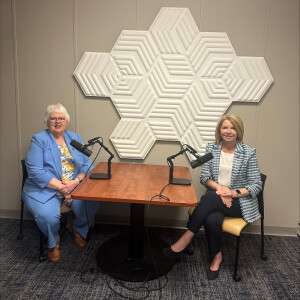
In this inspiring episode of Why I Teach, Dr. Christy Lawson, a trauma, critical care, and acute care surgeon at ETSU’s Quillen College of Medicine, reflects on her journey from a rural community in Georgia to the operating room and classroom. Blending stories of family, mentorship, and personal growth, Dr. Lawson reveals how formative experiences—from learning through storytelling with her grandfather to assisting in surgery during a mission trip in Honduras—ignited her passion for medicine and teaching. She discusses the emotional complexities of surgical training, the power of individualized mentorship, and the importance of nurturing students as whole people.
ETSU Quillen College of Medicine: https://www.etsu.edu/com/
ETSU Health: www.etsuhealth.org
ETSU Department of Surgery: https://www.etsu.edu/com/surgery/
ETSU Great Lecture Series: https://www.etsu.edu/etsu-news/2025/01-january/great-lectures-feature-handy-herrmann-lawson.php
Friday Apr 11, 2025
Friday Apr 11, 2025
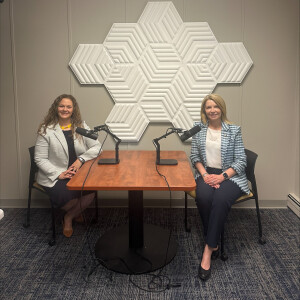
In this episode of “Why I Teach,” Dr. Flo Weierbach, a seasoned nurse and professor at East Tennessee State University’s College of Nursing, talks with Provost Kimberly D. McCorkle about her journey from providing direct care to teaching the next generation of nurses. With over 40 years of experience, Dr. Weierbach discusses her research on caregiver health, the challenges of rural health care, and the importance of interprofessional education for nurses. She also provides a snapshot of her experience with the Nurse Narratives Initiative.
Tuesday Feb 04, 2025
Tuesday Feb 04, 2025
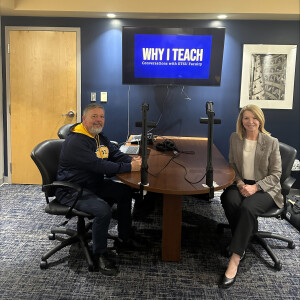
In this episode, Provost Kimberly D. McCorkle talks with Dr. Joe Moore, Director of Athletics Bands, Associate Director of Bands, and Associate Professor of Music, about the incredible ETSU Marching Bucs. In 2014, Dr. Moore was tasked with revitalizing the Marching Bucs, which had been dissolved a decade earlier. Under his leadership, the band has grown in both size and prestige. In 2024, the marching band became the first collegiate marching band from Tennessee in over 60 years invited to march in the Macy’s Thanksgiving Day Parade.
Thursday Dec 12, 2024
Thursday Dec 12, 2024
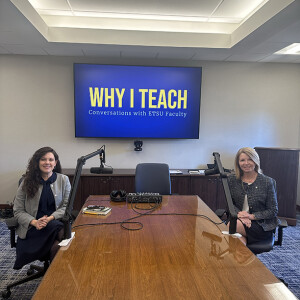
In this episode, Provost Kimberly D. McCorkle talks with Dr. Melanie B. Richards, interim director of ETSU’s new School of Marketing and Media, about how her experience in the corporate world led to a career in academia – and how she is harnessing that experience to make sure her students get hands-on, project-based learning opportunities in her classroom. Dr. Richards also discusses how she incorporates AI in her instruction and recommends a book that she has used to guide her research and teaching in this area: Co-Intelligence: Living and Working with AI by Ethan Mollick.
Listen to more episodes of Why I Teach, where Dr. Kimberly D. McCorkle explores stories of impact and success of ETSU faculty. Subscribe at https://why-i-teach-conversation-with-etsu-faculty.podbean.com/.
Dr. Richards’ Bio: https://www.etsu.edu/cbat/media-communication/facstaff/richardsm.php
ETSU’s Master of Arts in Brand and Media Strategy: https://www.etsu.edu/cbat/media-communication/academics/graduate-programs/brand-strategy.php
School of Marketing and Media News: https://www.etsu.edu/etsu-news/schools/marketing-media.php/
ETSU’s Approach to Community-Engaged Learning: https://www.etsu.edu/teaching/teaching_community/cel_qep.php
Wednesday Oct 23, 2024
Wednesday Oct 23, 2024
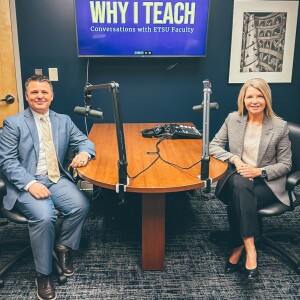
This episode features Dr. Michael Anthony Fowler, Assistant Professor of Art History in the Department of Art and Design at East Tennessee State University. In addition to his work in the classroom, Dr. Fowler is an active collaborator on several international archeological projects and serves as the chair of Johnson City’s Public Art Committee. In this episode, he shares how these experiences impact his teaching, as well as some interesting observations and insights about incorporating hands-on learning and interdisciplinary approaches in his classes.
Thursday Aug 22, 2024
Thursday Aug 22, 2024
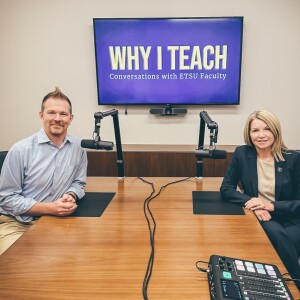
This episode features Dr. Scott Jenkinson, Assistant Professor in Clemmer College of Education and Human Development and a faculty fellow for Community-Engaged Learning at the ETSU Center for Teaching Excellence. He provides a wonderful snapshot of some of the ways in which community-engaged learning impacts our students and shares about his experiences with the ETSU Alternative Breaks program and some of the foundations for student success that he incorporates in his classrooms.